

Democracy Dreams
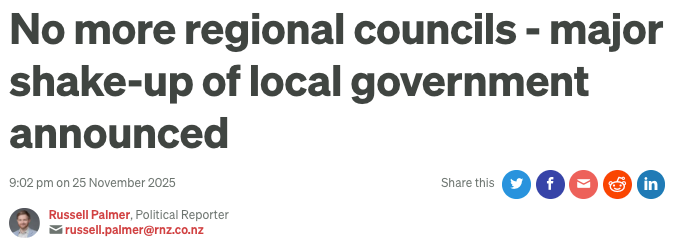
No more pesky Regional Councils.

Now here you go again
You say you want your freedom
Well, who am I to keep you down?
It’s only right that you should
Play the way you feel it
But listen carefully
To the sound of your loneliness
Songwriters: Stephanie Nicks.
A lot of us don’t have much to do with Regional Councils, unlike the City Councils, which look after our towns. But they fulfil a distinct and increasingly important role in managing development, resources, and things like water allocation, which are very important to others in the short term and to the rest of us in the longer term.
About 15 years ago, I was the Project Manager on a software development project for most of our regional councils, though a few, like ECan, decided to go their own way. It was complex and integrated with GIS systems, which are multi-layered electronic map solutions, for planning. It’s fair to say that the councils weren’t the easiest of customers.
Each Regional Council wanted to configure its workflows and set rules for application response times, and, of course, they were all different. They could’ve saved a lot of time and effort if they’d agreed on common ways of working throughout the country, but that, in my experience, was not the way that councils worked.
It’s not that they were being awkward; I remember the council representatives, especially those from Northland and Waikato, whom we saw more often and found them to be lovely people to deal with, who cared deeply about what they were doing.
Still, it all seemed a bit ad hoc, and I imagine that's how some of their customers feel.
With their focus on the environment and water management, they undoubtedly slow “progress” down. But they are an essential safeguard against unrestrained development that will create huge problems down the line if the impacts are not considered.
That’s what the coalition does when it comes to a tradeoff between managing development and allowing developers to go straight to “Go” with an unchecked green light. What could possibly go wrong?
The rest of today’s newsletter is for paying subscribers. Click below to continue reading, access newsletters, and join in comments for just $8 per month, or $80 for a whole year - less than $2 per week. I can’t afford to keep giving it away and would very much appreciate your support.
