

Once Were Warriors
What becomes of the homeless, the hungry, the imprisoned?

Mr Daddy long legs crawling up to the ceiling
The sun don’t shine the sun don’t shine the sun don’t shine at all
Mamma Pappa say you should go to school, I don’t know what for
Now that I’ve grown up and seen the world and all its lies
Song: South of Bombay.
The year was 1994, my first year at Uni in the big smoke, and I went with my mother and a family friend, Maureen, to the newly released movie Once Were Warriors.
I was familiar with the poverty and run-down state housing shown; my best mate lived in the area of Rotorua where Alan Duff’s novel was set, but from the opening, this movie was on a different scale. It showed the uncomfortable reality of what went on behind closed doors in a world apart, within our society. A world we knew existed, but didn’t think too much about.
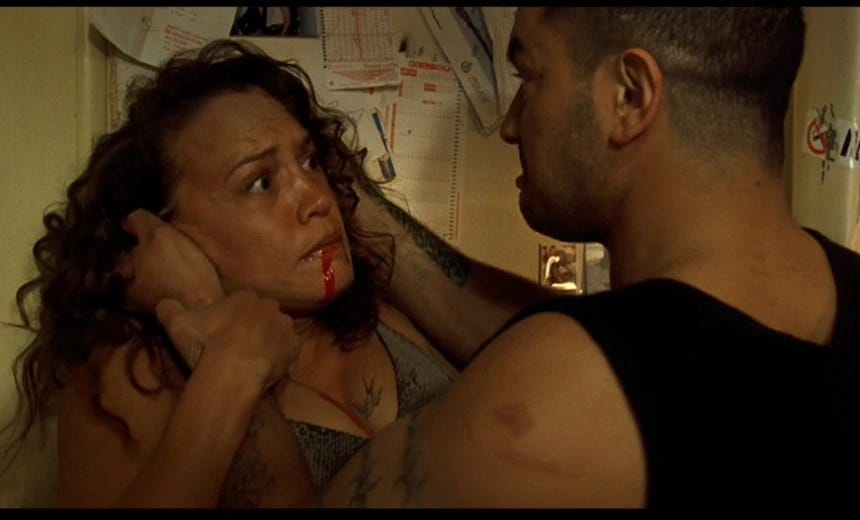
As the lights went up, I became aware that Maureen was crying, as were others in the theatre. Not short-lived sobs in response to a particular event, but an overwhelming grief at the lives portrayed.
Yesterday, the movie’s director died, and I posted:
Sorry to hear of the passing of Lee Tamahori.
Once Were Warriors is a movie that never leaves you.
My friend Liz wrote, “He changed our view of ourselves as New Zealanders. That film really put a fire up social justice and equity.”
Although it has been more than thirty years, I can still picture the scenes; they stick with you like guilt over the privileged life you live by comparison.
There were lighter times, too. The first time Fi and I moved to the UK in 1997, I became good mates with a Danish guy called Henrik, with whom I worked. He was taking me to what he considered quite a rough bar in St Albans, where he lived, and he was a bit concerned about the place, but I remember him joking, “You’ll be fine, you come from the land of Once Were Warriors.”
I’d spent the early 90s playing in some pretty rough public bars in my band, places where gang members would intimidate you or there might be fights in the car park as you arrived, but nothing like the images in Once Were Warriors. Henrik’s bar in St Albans, on the other hand, looked like a ladies’ lounge, for goodness sake, it was beige.
I thought about that movie and about our government today. With gang patch crackdowns, evicting those in emergency housing, feeding low-quality crap to kids in schools, and boot camps, have we learned anything?
It didn’t seem like it, and there is still so much domestic violence fuelled by alcohol and hopelessness that is unaddressed.
Boot Camps.
The final report is out on the government’s pilot that put young people into prison-like environments. The news felt like it came in slow motion.
We all knew the programme would fail; it had failed everywhere else, and the media seemed to be going through the motions, reporting on how badly it had done, as if it were a foregone conclusion, as if it were news that people already knew.
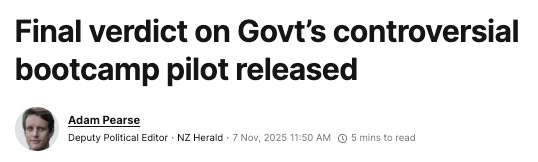
Out of nine pilot participants, six had reoffended within two months of being released back into the community, which is a disaster in anyone’s books.
However, it’s hard to deter ACT from claiming success over things that have clearly failed, and Children’s Minister Karen Chhour said the report “proves the 12-month programme was a successful pilot, even with the level of reoffending.”

Such failure has not deterred Chhour from rolling out the programme fully, and she said, “There are things that we need to work on, but I’m happy with what’s come from a pilot.”

ACT have a positive mindset; it doesn’t matter how bad the result of their actions is, they claim success and carry on.
School Lunches.
As with boot camps, there was an update on school lunches, another government policy that everyone thought would fail, that has indeed failed, and yet ACT keep carrying on as if it were all fine.

I posted the image above and wrote, “It’s still hard to believe that a government could be so mean-spirited as to target the food our children are given for cost-saving purposes. Meanwhile, this grinning gimp acts as if it has been a great success despite all the issues.”
The centralised model Seymour put in place with Compass Group has failed, beset by early problems with delivering food on time, burnt food, undercooked meals, food with plastic in it, as well as the ongoing issue of kids finding the food inedible and much of it going to waste.
The food was described on 1 News’ report as barely edible:
I don’t imagine the politicians will be adopting such a repetitive, bland, and unappealing menu at Bellamy’s anytime soon:

The scheme will now adopt a more regional approach, with a slightly higher budget of $3.46 per meal, bringing it closer to the pre-ACT settings.
Labour’s education spokesperson Willow-Jean Prime said, “We welcome the move back to local suppliers and raising the funding cap for some schools – but, with most schools still on the cheaper model, they should go further and fully reinstate the programme.”

Hiding the homeless.
As National’s plan to remove the homeless from sight progressed, it found some support in obvious quarters.
Mike Hosking was concerned that Luxon wasn’t cracking down quickly enough and wrote:
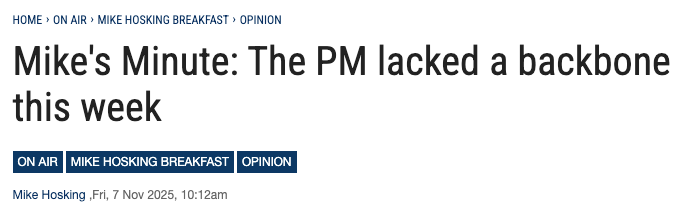
It was hardly breaking news that Christopher Luxon lacked a spine, but Mike’s issue was that he wanted the PM to harden up on how the homeless are treated.
Hosking wrote, “Homelessness for many is sad. Not all, but many. There will be addiction, and sorrow, and madness, literally and figuratively. You can get lost in that if you let yourself, and then you end up like the Labour Party – apologising for shocking outcomes.”
Literally warning his supporters from feeling empathy for those on the streets, like those Labour lefties, despite it being sad “for many”.
Mike bemoans that Labour backs the homeless; he accuses them of being “happy to wreck cities and businesses” and said of Luxon, “The Prime Minister failed to show up as a leader and run with a solution, because as he stood, his backbone vanished.”
Maybe as a Christian, Luxon was not in a rush to cast out the homeless, or perhaps he was waiting for his next trip overseas so it could be announced when he’s not here. I’m guessing it’s the second one.
Newly re-elected mayor of Auckland, Wayne Brown, was also enthusiastic and said, “I had to put up with the Prime Minister telling me that the town is scruffy. The town looks good, but the people in it are scruffy.”
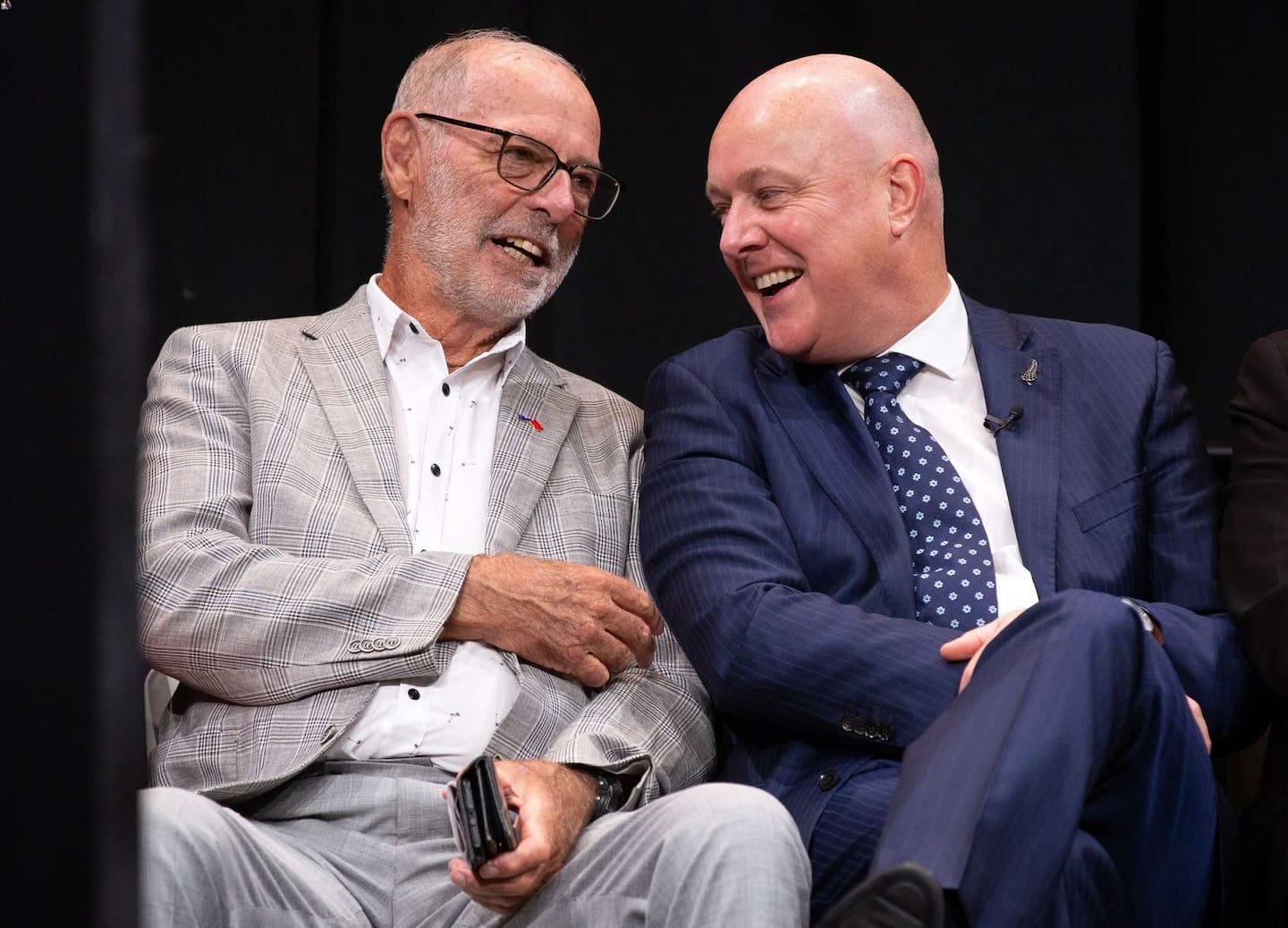
In his ever cantankerous way, the Mayor wanted it done yesterday.
From the NZ Herald:
“Well, I think they go out into the countryside,” Brown said of a possible location for downtown Auckland’s homeless.
“The other part about it is the economic damage they do. [It] depends on where they’re doing it. I mean, if there’s a scruffy-looking person sitting outside a pub in Ngāruawāhia right now, it’s probably not enchanting, but it’s probably not closing off wealthy foreign tourists from spending a lot of money here. So the economic damage depends on where you are.”
What an attitude - you homeless people can go and sit outside a pub in Ngāruawāhia, but don’t hang around here making the place look untidy.
Brown said, “I’m telling you [Prime Minister Christoper Luxon], that’s your job, mate. It’s not mine. I’ve made it nice. We’ve put planting in there. We’ve done all our other [stuff]. You go down there on a nice day and there’s no one bad around, it’s actually quite a nice place.”
As long as we have leaders who see the homeless, those battling addiction, and other issues as burdens rather than as part of the community needing support, we will keep hearing about scenes like those in Once Were Warriors.
Another child murdered, with no one willing to speak, another woman murdered because the state fails to deal with male violence, or simply kids growing up and feeling on the margins of society and that gangs will make their lives better.
It was a great movie, but it wasn’t fiction that broke our hearts watching; it was the ugly reality of life for some in Aotearoa. Lives that this government doesn’t care about.
In Aotearoa this morning, young children and abused women will wake to scenes reminiscent of that movie, and we must never turn our eyes away from them.
Have a good weekend, folks. Most of us don’t know how lucky we are.
I love bringing this newsletter to you. If you can afford a couple of dollars a week to support Nick’s Kōrero, it would be very much appreciated. Thanks for your consideration.
Ngā mihi,
Nick.
To end today, here’s What’s the Time Mr Wolf from the Once Were Warriors soundtrack:
The problem with right-wingers is: they are hard wired not to have an imagination. It is easy to denigrate the poor and the homeless because they aren't capable of imagining what it must be like to be them. The easiest thing to do is to cart them off into the wilderness where they are seen and not heard.
That is how the right-wing deals with problems. Turn their heads away, pretend they don't exist, ignore the warning signs and don't do anything about them because that would mean they have to admit they exist. As an example, look at the pitiful response to Climate Change. The poor and oppressed come into the same category.
In Iceland and Germany - at least - they have custom built shelters or pods where people can be out of weather in quiet alleys and warm and comfortable until alternatives are found. Auckland and other cities need this now. Then a massive increase in community workers, hostels and apartments and retirement villages for renters are needed. Healthy people and housed people become productive people. The answer to hopelessness is real hope.
A Government with intelligence and ability to think outside their square heads would know this. It would contribute to the economy, GDP and all the goals they value, but they do not have a clue how to achieve a well and successful community and economy.
Four shorter days in a week, living wage - below which employers are criminals - and increase productivity and volunteerism. Healthy community healthier economy.