

The Opportunity Party
Things to be aware of when voting for the Blue/Green alternative.

I've been wrong before
And I'll be there again
I don't have any answers, my friend
Just this pile of old questions
My memory left me here
In the field of opportunity
It's plowin' time again
Song: Neil Young.
TOP have come a long way since they leapt into the nation’s consciousness in 2017 on the back of Gareth Morgan, a surprising anti-cat stance, and insulting Jacinda Ardern as lipstick on a pig. Or have they?
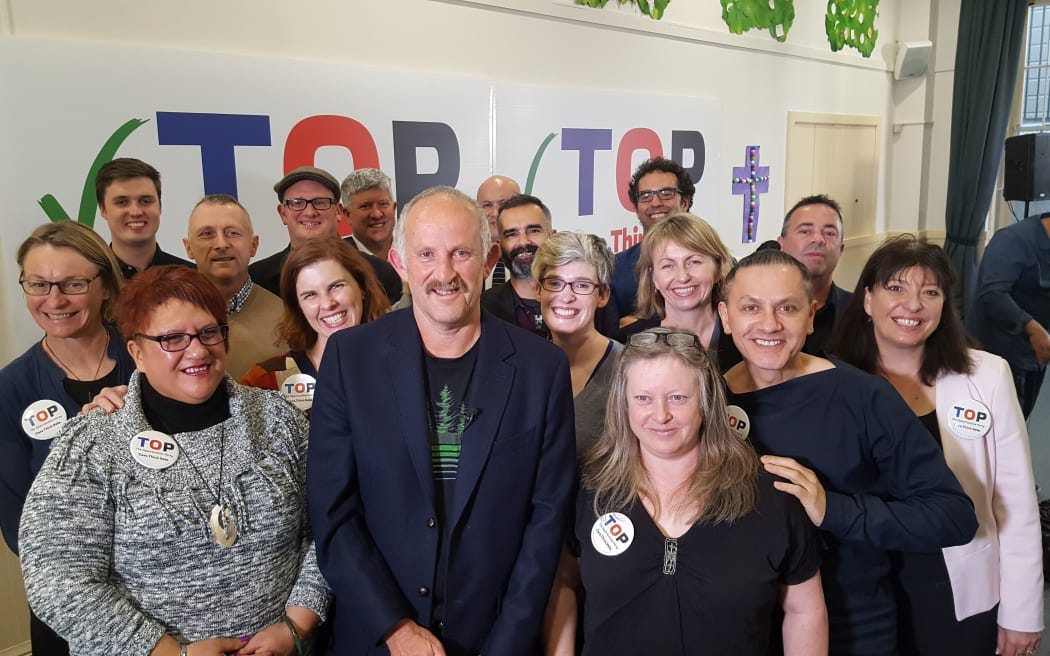
Certainly they’re a lot less gruff around the edges, but they still haven’t entered parliament or broken through the 5% barrier in any of the credible polls - I’m looking at you, Roy Morgan, although they have changed their name.
With a distinct lack of brand awareness among a public that was mostly surprised to find it still existed, the party formerly known as The Opportunities Party renamed itself the rather more singular The Opportunity Party. Ta dah!
Perhaps deciding that such a dramatic name change hadn’t delivered the media splash they had hoped for, TOP also went looking for a new leader, not from within the party ranks of true believers, but advertising the job to all and sundry on Seek:
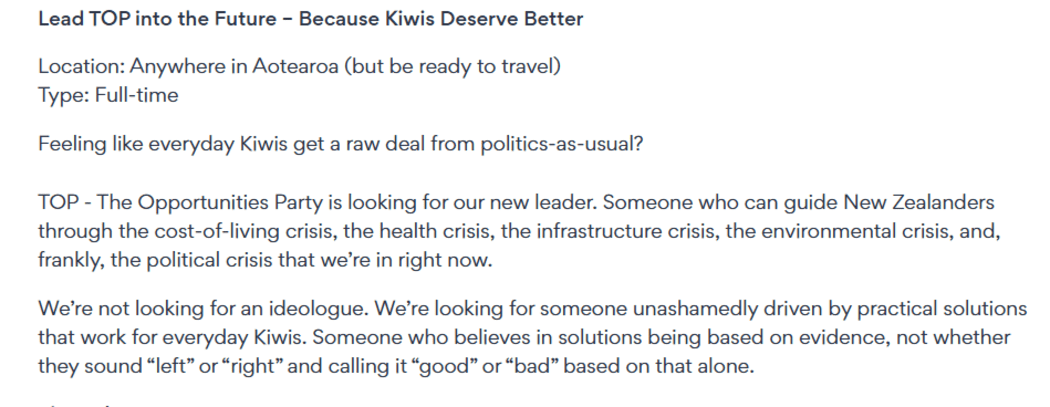
At the time, I thought the process was somewhat comical, but they seem to have chosen an applicant who can play the part well, with the memorable, James Bond-sounding name ‘Q’, short for Qiulae Wong. The Auckland-based business consultant has proved to be highly personable and refreshingly positive for a politician.
Just a note about those Roy Morgan polls: for some reason, that organisation regularly reports minor parties higher than they really are and major parties lower; I’ve learned that the hard way over the years as a Green supporter. While a recent Roy Morgan poll showed TOP at 6%, no poll from any other polling organisation has shown TOP even reaching 3.5% at any point in the entire cycle since the last election.
In fact, TOP’s top-ten poll results since the last election have all come from Roy Morgan polls. So that brings us to the two main issues someone should consider when voting for TOP:
Will they be there? There is no electorate where they look likely to win, and unless they are regularly polling above 5% (which they certainly aren’t), people will be wary of wasting their vote in an incredibly important election.
If TOP are elected, will they seek to enter government with the opposition or join the coalition? They’re not saying.
In a recent interview with Guyon Espiner, Q said, “We’ve openly said we would work with either National or Labour... We don’t have a preference, and I think that’s an important line to maintain... because that’s what creates the stability and stops that pendulum from swinging so far from the left and the right.”

It’s certainly a pitch for the middle, although, as the late and scarcely lamented United Party found, there is precious little room between the Red and Blue behemoths.
Recently I posted:
If you wanted to change the government, why would you vote for a party that recruits a leader and attracts big-money donations, like TOP, when you can vote for the real thing?
If you want to change the government, vote Labour or the Greens; don’t waste your vote on a party that might form a coalition with National and almost certainly won’t be in parliament.
Michael replied, “Nah, I'll be voting for TOP if they are close to 5%. Labour's major tax reform is a Clayton’s CGT, which will make a pitiful difference. The Greens are far more admirable, but their proposed taxes are inefficient and potentially avoidable by the wealthy. A small land value tax would allow for transformational income tax cuts for low- and middle-income households. Potentially even as high as a $50k income tax-free threshold. Not to mention the positive flow-on effects from it and the inability to escape it.”
David wrote, “I keep seeing this argument - ‘vote TOP, they have some sensible policies’, yet they only bounce around 2% support. Are they a panacea for disillusioned Natz, recovering ACTites, or spurned NZF voters who just can't bring themselves to vote Labour and are terrified of the Greens?”
Simon commented, “Personally, I feel like TOP are just centre-right who've worked out that greenwashing is a great marketing strategy.”
Leila said, “I'm sick of hearing people on the left voting TOP. You are not left if you are happy with a party that will work with National.”
So how about those policies?
The TOP Party site has a comprehensive list of policies they are presenting to the electorate, which puts a number of other parties to shame, and it’s good stuff.
Protecting our oceans in ways that would have Shane Jones choking on his mid-morning crayfish pie. A focus on cheaper, more sustainable power that would see David Seymour weeping for shareholders, and incentives for investment in Research and Development; these sound like a party of the 21st century, a far cry from their potential coalition partners on the right.
The big one, though, is the tax policy: “a Citizen's Income so everyone can afford the basics, a Land Value Tax to lower house prices, and Kiwisaver 2.0, a compulsory superannuation system.”
I strongly support a Universal Basic Income, such as that proposed by TOP. In a future where AI will increasingly render more and more of us redundant, such a scheme will be the difference between a fairer society that shares some of its wealth and a dystopian nightmare of extreme wealth and mass poverty. It also makes sense to support young people in their education.
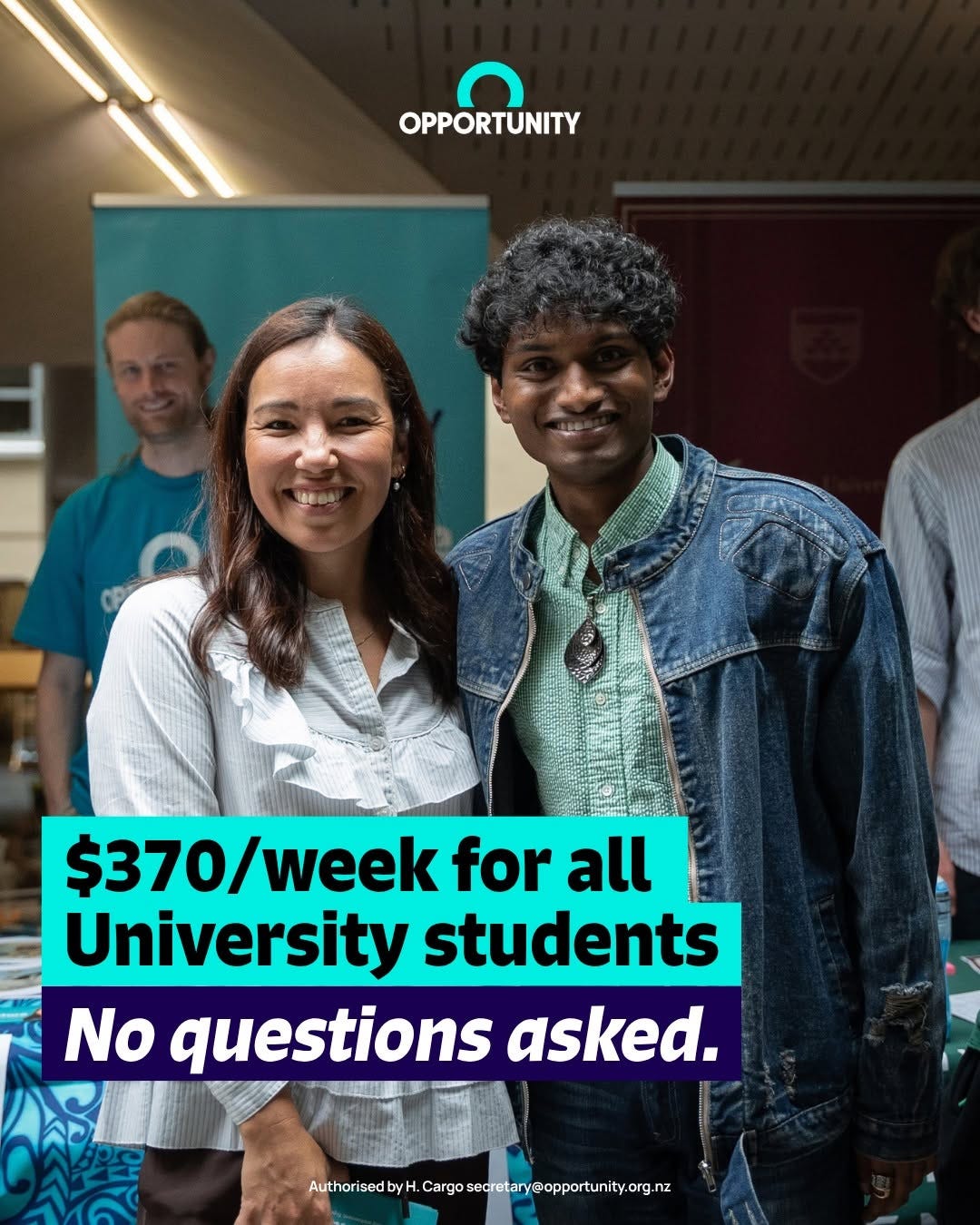
My one concern with the policy is that, as the payment replaces Superannuation over time, I’m unclear about what safeguards would be in place to ensure income levels are maintained. It would be easy for future right-wing governments to allow the value of support to erode across the board.
Making KiwiSaver universal, as they propose, is a no-brainer. Our Aussie cousins have mandatory savings at a higher rate, and they’re better off for it.
The thing is, I agree with most of the policies; they’re not so far from the party I support, the Greens. What I don’t understand is the need for a bluer Green party, one that won’t scare the middle class by hugging trees or the poor too closely.

I posted the question:
Are you considering voting TOP? You know the risks of them falling below 5% or of going with the Nats, so is it a specific policy or something new?
Dorothy replied, “Political parties are born out of action from communities. TOP doesn't have that kind of background. It was established by Gareth Morgan, a wealthy man, and had to advertise for a Leader. It is not a genuine movement that grew out of a background of fighting for fair treatment of workers and their families.”
Dallas said, “TOP is a breath of fresh air...the Left should embrace their humane policies, even if we don’t vote for them...”
Darien wrote, “I am more and more suspicious that TOP is a party created by AI with corporate overtones. Think about it. I can’t see any grassroots activism. Everything is decided by a small board.”
Sian said, “Nope, nope and nope. They are centre-right, and I don’t align with them. Sure, some promises of good policy, but that doesn’t mean they will deliver, especially in government with the right-wing parties. A vote for them is a vote away from the change we need.”
Having looked at their policies, I would say they are more left than right, but they are determinedly straddling that centrist role, and I genuinely think they could go either way.
Why does it matter?
Yesterday’s TPU/Curia poll showed that Labour, the Greens, and Te Pāti Māori had 46.8% of the vote between them. While they may pick up a few overhang seats, it’s not enough to beat National, NZ First, and ACT, who had 49.3% support between them.
In the same poll, TOP had 3.2% support, which would be wasted votes because they would fail to enter parliament. Alternatively, if those people had voted for one of the opposition parties, the result would have been reversed, with a narrow victory for the left.
If TOP attracts 3-4% of the vote on election day from those seeking change from what we currently have, it may well be the difference between the left being in the game and the existing coalition being returned.
I understand why TOP wants to play both sides to pick up voters from the left and right, but at some point you have to question how serious they are about some of their progressive policies if they are open to entering government with parties that certainly would not support those policies.
You want people who unashamedly stand for what they believe in; we don’t need another kingmaker who will sway with the winds of favour.
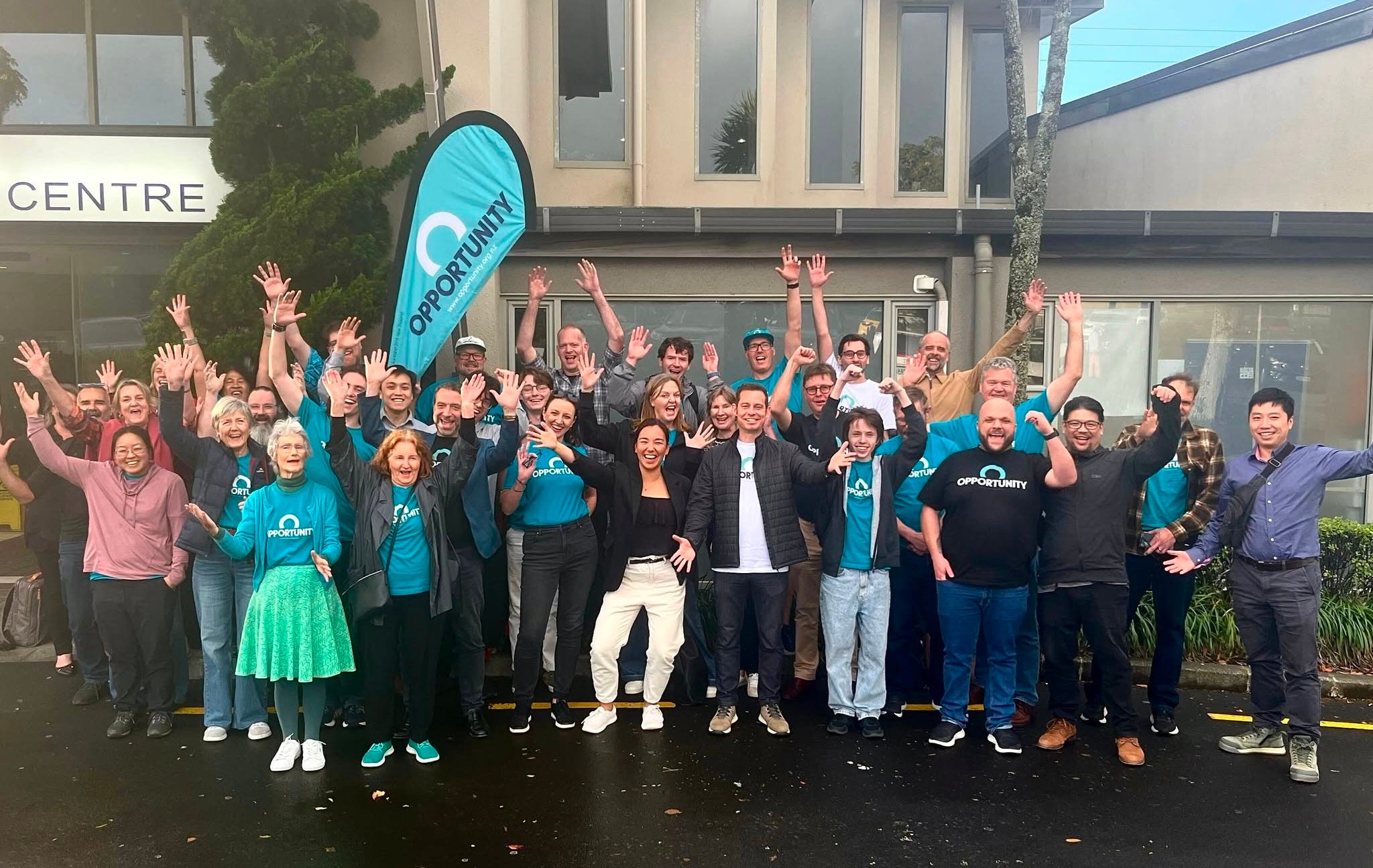
Good luck to TOP; they certainly have some good ideas. If what they’re offering is your choice, then fair play to you; my point, though, is that people should be very clear about what they are voting for and the associated risks.
Maybe you’ve agreed with my thoughts; maybe you haven’t. Either way, I hope you found this interesting and/or entertaining. If you enjoy my writing, this would be a great opportunity (sorry) to subscribe, receive every edition and help fund my work.
Thanks for reading, and take care, all you lovely people. 🙂
Ngā mihi,
Nick.
To end today, here’s Neil Young with Field of Opportunity.
Look at who TOP get their big donations from, and ask yourself - what do these donors expect? My guess is they expect TOP to take votes from the Greens, to improve the crap coalition's chances of reelection. The party is carefully crafted to do just this. If TOP did find itself in parliament, it has little chance of its more attractive policies being adopted. Vote Green!
Very good points, Nick. Whatever TOP is offering, whether we like it or not, we absolutely must vote strategically in this election. The current coalition has proved itself to be so dangerous, we must to everything we can not to risk their reappearance. The fact that TOP has said they could work with them should ring alarm bells to anyone who values their children's futures.