

Suspending Protections
Chris Penk and the Building ACT.

'Cause you're working
Building a mystery
Holding on and holding it in
Yeah, you're working
Building a mystery
And choosing so carefully
Songwriters: Pierre Marchand / Sarah Ann McLachlan.
Until the end of January, this Saturday, you can get 20% off a subscription with my “Nick’s Ditch the Pricks in 26” special, bringing the price to $64 for a year, or $6.40 per month, rather than the usual $80 or $8. Come on in. It’s going to be a big year.
We all remember the leaky home crisis, right? Where thousands of Kiwis found themselves hundreds of thousands of dollars in debt through no fault of their own, as the untreated timber within their walls turned to soggy Weet-Bix and their house value plummeted.
This was all made possible by the National government of Bolger and Richardson in 1991 with their amendment to the Building ACT that changed things so that materials were not “prescribed”, you know, like thou shall use treated timber to stop it turning to mush, and was modernised to a “self-regulated” regime meaning that if you think a bit of plaster is going to keep the rain from ever getting to the timber inside the wall cavity then Bob’s your mother’s brother.
Hmm, a National party that has strangled the economy with austerity, leading to high unemployment, desperately deregulating in the hope of reviving business activity. Sound familiar?
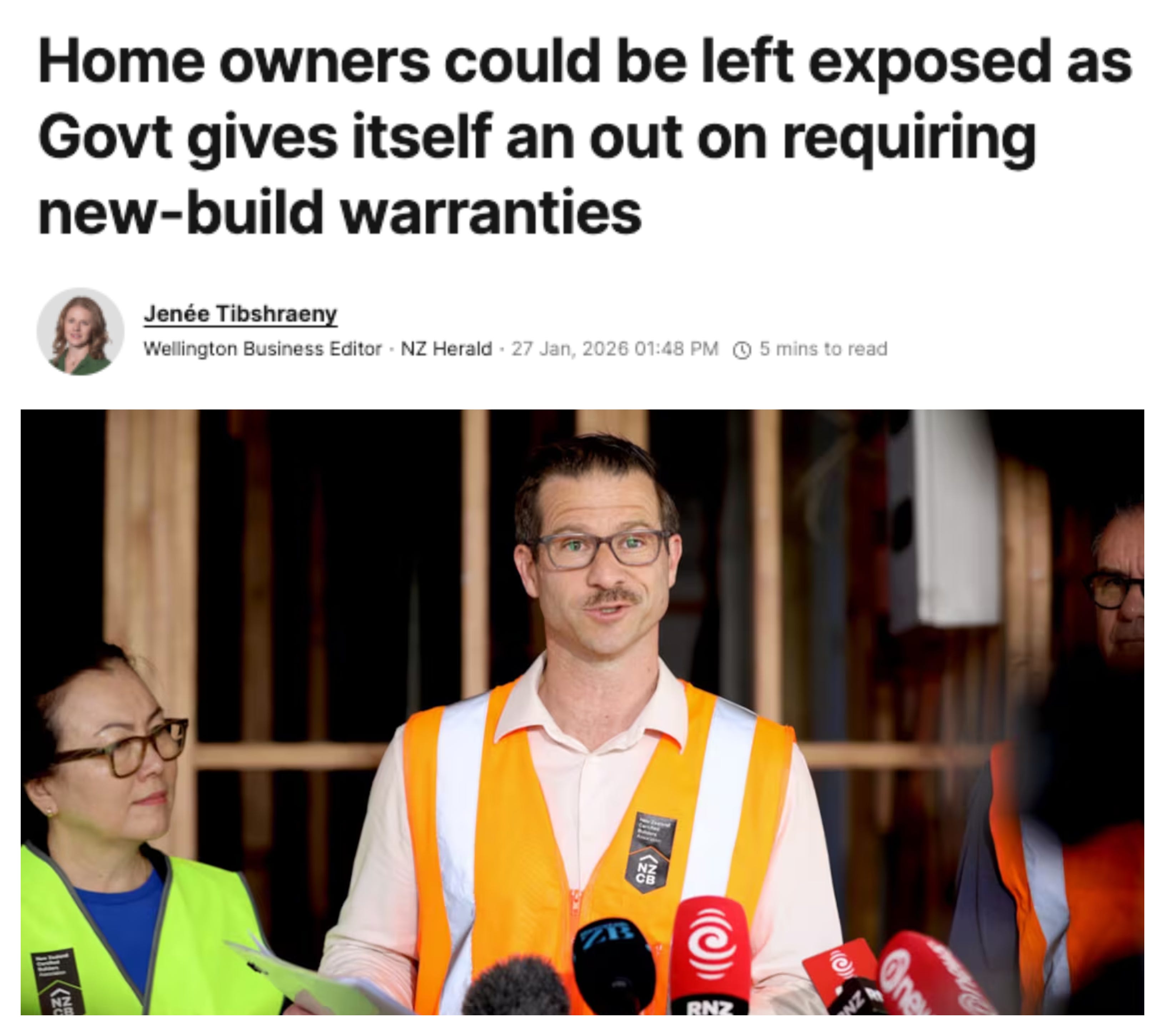
Jenée Tibshraeny writes in the Herald (paywalled) that home owners could be left with the costs of defective work on their properties once this government has overhauled the Building ACT.
There goes that sense of déjà vu, again.
They’ve kept it very quiet, but the coalition government “plans to give itself the ability to temporarily suspend the requirement for consumer protections to be put in place in the building sector, if the providers of these protections bail out of New Zealand or their offerings become too expensive.”
Or to put it another way, if those underwriting developers deem the risk too high and exit the market or increase their prices too much, the government’s response will be to say, “never mind, Mr Developer, we’ll just suspend those pesky consumer protections. As you were.”
Before you yell, “How grossly incompetent, whose side are these guys on, developers or home owners?” fear not, the government has an alternative in mind.
From the article: “In November, the Government announced it would require those who build or renovate their homes to buy warranties or insurance on the building work.”
Talk about passing the buck, surely it should be on the people doing the construction to provide a warranty for their workmanship, not on the customer? This is, after all, a house, not some short-lived piece of technology that you buy an extended warranty for at a mall.
To be fair, the government is also making it mandatory for professionals involved in building work to have professional indemnity insurance, although, to be honest, I would have assumed that was already the case.
I suppose on some level this makes sense. Of the three parties involved in leaky home disputes, often the homeowner was the one out of pocket. Maybe it’s easier for them to hold the insurance, provided the cost savings of the other parties are passed on to them. What we saw from the other parties during the leaky home debacle was building companies going bankrupt, with the same people then starting new companies soon afterwards, washing their hands of the misery they left behind, and councils dragging their heels for years.
Building and Construction Minister Chris Penk expressed confidence that warranties/insurance would be widely available to developers. So much so that he neglected to mention the government’s alternative of suspending consumer protections.
Oops.
“The Herald became aware of the caveat in the policy by reading government papers, released some time after Penk announced warranties/insurance would be mandatory.”
Fans of The Hitchhiker’s Guide to the Galaxy are probably imagining this scene about now. Chris Penk is being played by a man called Mr Prosser, and the rest of us are represented by Arthur:
Mr Prosser: But, Mr Dent, the plans have been available in the local planning office for the last nine months.
Arthur: Oh yes, well as soon as I heard I went straight round to see them, yesterday afternoon. You hadn’t exactly gone out of your way to call attention to them had you? I mean like actually telling anybody or anything.
Mr Prosser: But the plans were on display…
Arthur: On display? I eventually had to go down to the cellar to find them.
Mr Prosser: That’s the display department.
Arthur: With a torch.
Mr Prosser: The lights had probably gone out.
Arthur: So had the stairs.
Mr Prosser: But look, you found the notice, didn’t you?
Arthur: Yes, yes, I did. It was on display at the bottom of a locked filing cabinet stuck in a disused lavatory with a sign on the door saying ‘Beware of the Leopard’.
Not that there is much to find in this case, as the plan is rather open-ended, with the cabinet agreeing that consumer protections can be suspended at any time for up to 2 years and then extended by up to 2 more years. No wonder they’ve kept it so quiet.
Still, don’t forget, Minister for Building and Construction Chris Penk is confident that insurers will offer developers these products, so there should be no need to go down that road.
Right, Chris?
“New Zealand’s insurance market relies on overseas reinsurers, who may withdraw if systemic building defects emerge or following major shocks such as natural disasters,” said Penk in the Cabinet paper.
Sorry, what? Fully confident, no need to worry, and then you tell us that one of the circumstances in which you might “need” to suspend consumer protections would be in the wake of multiple natural disasters.
Firstly, we’ve had quite a lot of those recently, if you haven’t noticed, and secondly, isn’t that exactly when you need insurance? If Big Insurance decide they’ve paid out after one too many storms, what the heck are we supposed to do next year, when the next one comes?
MBIE supports the government's policy of distributing responsibility, but they were singing a very different tune back in 2019. Funny how that works.
“Proportionate liability wouldn’t protect homeowners from financial loss, and may deter guarantee and insurance providers from entering the market due to the lower likelihood of recovery of damages from others in the system.
Homeowners would find it hard to show how much each defendant contributed to their loss. Court costs are likely to increase as the parties dispute their proportion of contribution.”
In my view, it makes no sense to have the consumer, rather than the producer, responsible for warranting a product.
Yes, there is an issue with builders declaring themselves bankrupt and then starting again, leaving their debts behind. I think the government should move to stop that with a long stand-down period before someone can just start up again if they haven’t put right the previous work, and have left customers in the lurch.
If overseas insurers decide to exit the market, then, in my view, the onus is on the government to underwrite our local insurers. It’s not perfect, but it’s a damn sight better than unloading the responsibility onto the homeowner.
By now, some of you might be thinking this Penk is a bit of a plonker, isn’t he? Well, make sure you don’t have a mouthful of your favourite morning beverage in your mouth, because yesterday this happened:
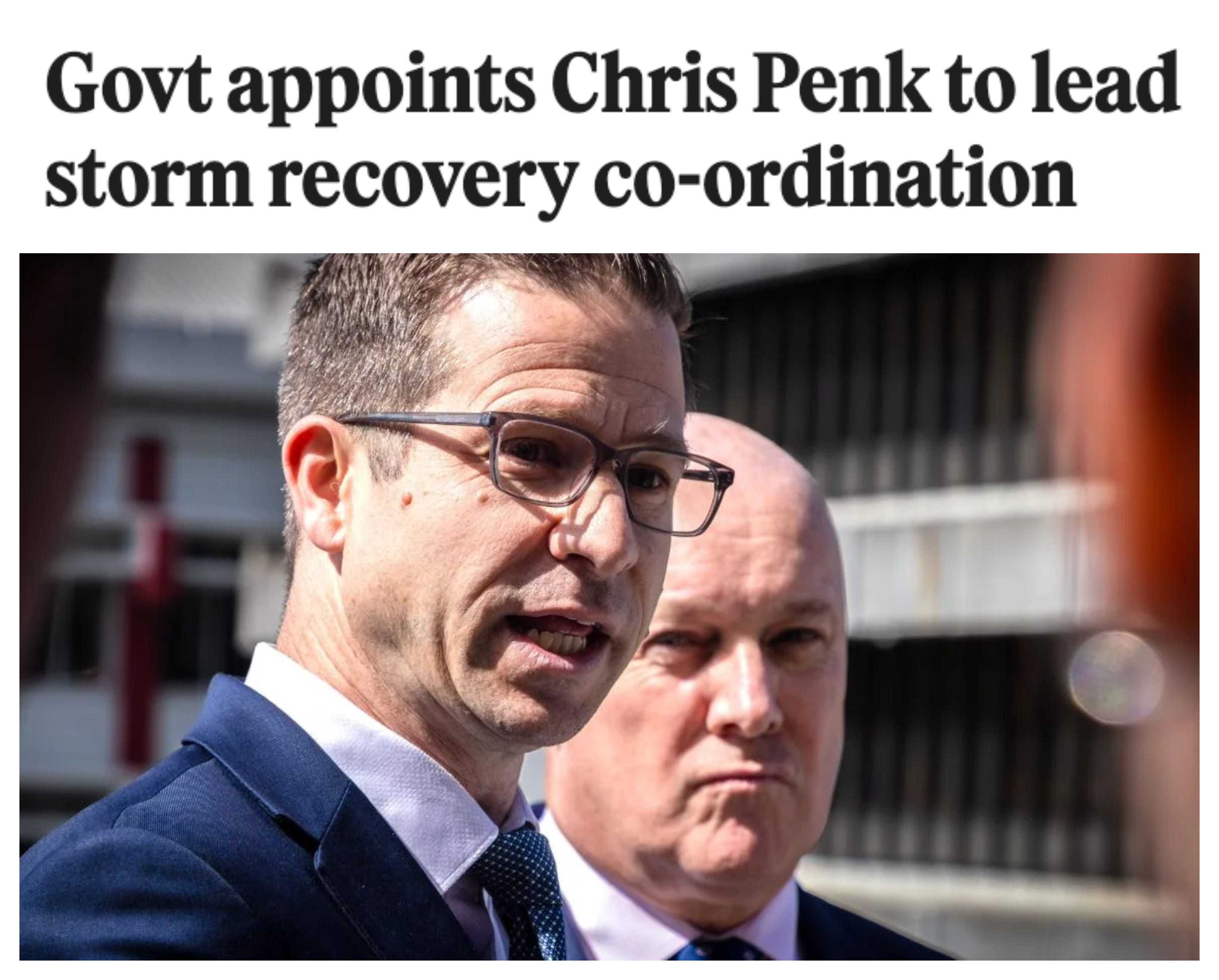
Mmm, I think I might have to consult the Hitchhiker’s Guide to the Galaxy to see what it has to say about this sort of thing.
Take care, all of you lovely people, and have a good Wednesday.
Ngā mihi,
Nick.
To end today, here’s Sarah McLachlan with "Building a Mystery”; today is her 58th birthday.
I think that the only sanction that we have for useless politicians - voting them out- doesn't concentrate the mind sufficiently. Perhaps what we need is a law which will make politicians liable for damage caused by their policies, after they cease to be in government?
This government takes no responsibility for anything.